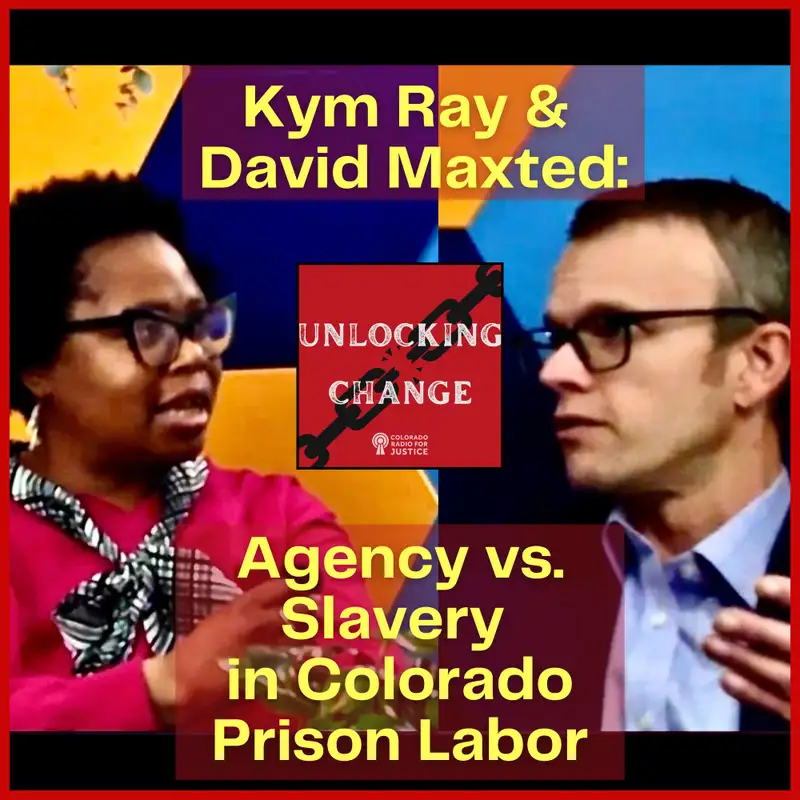
Kym Ray & David Maxted: Agency vs. Slavery in Colorado Prison Labor
Introduction
---
Joybelle Phelan: Hello, and welcome to this episode of Unlocking Change on Colorado Radio for Justice. I'm your host today, Joybelle Phelan, and I am joined by Kym Ray, [00:02:00] Co-Chair of End Slavery Colorado, and Dave Maxted with Maxted Law, and we're going to be talking about the 13th Amendment, slavery, a recent lawsuit. And~ we're gonna be talking~ about stepping away from the headlines and really digging into the history and how things are changing in Colorado. Thank you so much for being here today.
Kym Ray: Thank you.
David Maxted: Thank you for having us.
The 13th Amendment
---
Joybelle Phelan: So let's start with, in 1865, the 13th Amendment formally ended slavery in the United States, but it included an exception allowing involuntary servitude as punishment for crime. In 2018, Colorado voters removed that exception from the state constitution, and more recently we've had a Denver District Court ruling.
So let's start in 1865. ~What, ~why did the 13th Amendment include an exception clause allowing involuntary servitude as punishment for crime?
David Maxted: ~You want, you don't you take that one first. ~
Kym Ray: ~Well, I can do that. Um, you know,~ With the ending of slavery, obviously not [00:03:00] everyone was excited, right? But I think that it allowed for a loophole for people, ~to more specifically, ~let me be very specific: Black people
Formerly enslaved people, for slavery to For slavery to be continued. That was, in my belief, the reason why there would be an exception for it to not just say there should not be any slavery or involuntary servitude, period.
Joybelle Phelan: ~Okay. Anything else you wanna say about that?~
~Okay. Let's talk about how, ~since you're talking about post Civil War era, let's talk a little bit about how was that exception used in the decades after the Civil War?
Kym Ray: ~Well, I mean, I think we saw, you know, from everything from Black coats to, um, were, ~As folks were experiencing "freedom", We saw people getting arrested and put into chain gangs for very minor things that really shouldn't be crimes.
Things such as loitering, or if there were more than [00:04:00] so many Black people standing together, you could be arrested and thrown into, um, chain gangs and go to prison.~ And as we saw a lot of those pr, um,~ Even currently, prisons such as Angola were actually plantations. So those plantations shifted right over into prisons.
Joybelle Phelan: ~Mm-hmm. Mm-hmm. So how might you respond? Um, so ~
Convict Leasing
---
Joybelle Phelan: People in America may have heard the term "convict leasing." What was that? How did that help to shape prison labor in the states?
Kym Ray: ~Did you wanna share that? ~
David Maxted: ~Sure, I'll do my best and Kym can fill in, but I don't know. 'cause she knows more. Um, no, I, and I agree with Kym that ~The background of the 13th Amendment was to allow slavery, involuntary servitude for certain folks.
And so convict leasing is one way that that occurred. Basically, I guess people call it slavery by another name, but it was slavery, essentially, where people were getting you know, leased out, sold out to to work because they're convicted of a crime. So the Constitution in the 13th Amendment actually allowed that legally to occur, which is kind of bizarre, but even though it was abolishing slavery, [00:05:00] was specifically writing into the Constitution that it was legally allowed, uh, for those convicted of a crime. Not just involuntary servitude, but slavery that's still in our constitution and in the 13th Amendment, so that's legal today under the U.S. Constitution. So convict leasing was one manifestation of that.
So it was, you know, as Kym said, it was just a way of continuing oppression, continuing slavery through the arm of the, you know, the arm of the state.
Joybelle Phelan: ~Mm-hmm. Anything you wanna share about that? ~
Kym Ray: ~No, I think he hit it right on the head, ~
Joybelle Phelan: ~like, ~so that leads into the next question: How did prison labor evolve from that period into this more modern correctional system that we would have now?
Slavery Evolves Into Present-Day Prison Labor
---
Kym Ray: ~Well, I think it's very much what, you know, David said, you know, um, ~as the prison complex, like as it has expanded, the use of inexpensive or free labor because there are definitely some states who still do not pay, um, folks that are incarcerated. Um, and it's just become commonplace of like the, the norm, so to speak, of like, this is [00:06:00] what it is.
~And also, um. Like Dave said, ~it shifted to slavery underneath another name. ~Mm-hmm. Right. But folks don't necessarily see it as slavery. And as we have people started thinking and how we think about people who are incarcerated, um, people all, you know, the, the public sometimes thinks that that's what it's supposed to be.~
~Mm-hmm. Because we haven't known it to be anything else. ~
Joybelle Phelan: ~Mm-hmm. Mm-hmm. Anything you wanna share there? ~
David Maxted: ~I think it's, um, no,~ I agree with Kym and I think it's evolved over 20th century into where we are. Mm-hmm. So people sometimes think about it like they're imagining, I don't know, people on a chain gang or something.
Joybelle Phelan: Mm-hmm. Mm-hmm.
David Maxted: And it's not, that. Up through the 20th century up to now, People do really hard work. Mm-hmm, In prison, very physical work out in the sun. Whether it's groundskeeping, whether it's, you know, manual labor. They're maintaining the facilities, they're doing, they're cooking meals, you know, for thousands of people in hot kitchens and doing really hard work.
Um, which is- under this threat of, of coercion under this threat of this threat of punishments- which are, you know, are akin to involuntary servitude, in which now a district court is held, can be a condition of, you know, an [00:07:00] uncon, an unconstitutional condition of slavery or involuntary servitude.~ So. It's the way that it's been, the way that it's evolved, the, the labor maybe has changed in some ways, but it's um, it's still very coercive 'cause it's in prison in the context of prison.~
Joybelle Phelan: ~Right. So let's come forward a little more recently. ~
Colorado Removes Exception Language from Constitution
---
Joybelle Phelan: So back in 2018, voters, Colorado voters removed that exception language that we're talking about from Colorado State Constitution. What exactly changed in that text at that time?
Kym Ray: So during that time, and, you know, we referred to that as amendment A. Okay.
Where like, overwhelmingly, like over 60% of folks in Colorado voted to remove the language. So previously the Colorado Constitution read like our federal constitution. Um, there shall not be any slavery or involuntary servitude except for, um. Being convicted of a crime. I'm very short phrasing, but mm-hmm.
Um, after that ballot measure passed, it became, there shall not be any slavery or involuntary servitude period.
Joybelle Phelan: ~Okay. ~
Kym Ray: ~Right. No ~
Joybelle Phelan: ~exception ~
Kym Ray: ~was added. No exception, uh, that exception clause was removed. ~
Joybelle Phelan: ~Okay. ~
David Maxted: ~Yeah, no, and~ I think, um, one of the things we learned [00:08:00] as we really dug into the lawsuit. Is, if you look back at the language of the, what the voters approved, the brilliant activists like Kym and others who got into the what the voters approved people specifically said, look, opportunities to work; voluntary labor; rehabilitation?
That's great. People want opportunities to work, but what they said was gonna be unconstitutional by removing that exception, was forcing people, coercing people, compelling people. Voters said that the state should not have that power period, including in prison. So give opportunities, make it voluntary, but remove the power of the state to compel it or coerce it.
And so I think. To having that language out, but also knowing what voters were thinking about when they approved it is really important.
Was the Constitutional Change Symbolic or Substantive?
---
Joybelle Phelan: So since you were involved with that, Kym, I'm curious, at that time when you were building amendment A, was that viewed as symbolic or substantive or somewhere in between?
Like [00:09:00] what was the, the thought process as you were creating amendment A?
Kym Ray: ~So, um. ~It was definitely not symbolic. We definitely expected and hoped to see change. ~Um, as David mentioned, we were not trying to remove work programs. ~It was not supposed to change work programs like they were to exist. People want to work.
This is how people earn their money, um, to be able to survive. However. Like David said, we did not want people to be punished. We didn't want people in solitary or restrictive housing or any of those things, um, for choosing not to to work. ~That was really what it was all about. ~
Joybelle Phelan: ~Okay. So it was really ~what I'm hearing you say is that the point of that was just to end the exception of being forced to work.
In slavery conditions.
Kym Ray: Mm-hmm.
Joybelle Phelan: In our constitution.
Kym Ray: Exactly. And you know, like kind of looking in a crystal ball, we would hope that the work that folks would do, um, would actually translate into - you know, we would change the way that labor is viewed in [00:10:00] prison. Um, so we want folks to have meaningful work that would set them up for success when they come home.
~As we know, most of the folks that are incarcerated are going to come home at some point, so we wanted them to be able, we wanted that line. We wanted people to be set up for success. ~
Joybelle Phelan: ~That makes sense. ~
How Does Constitutional Language Impact Corrections Practice?
---
Joybelle Phelan: So did that amendment automatically require changes in Department of Corrections policy, or does constitutional language typically require judicial interpretation?
David Maxted: It doesn't necessarily require that. If the department. This the day that that passed by. Voters could have, and I would argue, should have reviewed what they were doing, reviewed policy and made affirmative changes voluntarily to ensure that they were complying. One of the things we learned during the lawsuit and came out publicly in court was that.
The Department of Corrections to this day has failed to do any kind of an audit or review of their own policies to see whether they're in compliance with Amendment A, with this ending the exception. So no study has been done, no internal review, no audit. To really assess [00:11:00] in a meaningful way, are we, are we still coercing people against their will?
Hmm. Or are we not, are we in compliance? ~The lawsuit showed that they're not in compliance. Mm-hmm. But they didn't, they did not voluntarily even entertain whether they should review, uh, whether they're in compliance. ~
Joybelle Phelan: ~So at that time, like we're still talking about 2018 Amendment A. ~So at that time, ~it was just changing the language, not just, ~it was changing the language in the constitution.
Full stop. It didn't go past that
Kym Ray: For the coalition. Mm-hmm. That actually worked on Amendment A. That was where we stopped. Okay. Um, with hopes that, you know, we would actually see the things that David talked about that, you know, department of Corrections would say. Great. Let's take a look. Are we doing this?
Are there policies that we need to change? Um, and then open the door for even possible legislation, um, litigation if need be as we're seeing, um, those sorts of things. But that's where the coalition stopped 'cause we hope that that was a door that we kind of opened a little bit for folks to be able to walk through.
Okay.~ Okay. ~
Joybelle Phelan: ~No, that's just helpful. This is part of the history list lesson we're trying to share. Right. So then. If I, if I remember this correctly. So this lawsuit actually started four years ago. Is that right? ~
David Maxted: And I think the, you know, the genesis was even before that. Okay. Because people started reaching out.
So people in prison realizing, wait a minute, the law changed, the [00:12:00] constitution changed, but nothing's changed in here. So. Mm-hmm. People start complaining. They're filing grievances, their. Talking to lawyers, I forget, wait a minute, what are our rights? What should be happening?
Joybelle Phelan: ~Mm-hmm. ~
David Maxted: So folks started contacting, you know, civil rights lawyers like me towards justice advocates like Kym and, and the, the coalition.
And it was just an outpouring of interest and people concerned that their rights were being violated. ~Okay. So then that, uh, built into the lawsuit, which was filed. Um, I believe in. It's been so long now, early 2022. ~
Joybelle Phelan: ~Okay. Yeah. ~
Are Incarcerated Coloradans Still Being Forced to Work?
---
Joybelle Phelan: So as I understand it, the central issue in this case was whether incarcerated people could be punished for refusing to work.
Is that accurate?
David Maxted: Not, not quite just punished, but coerced. So the question with involuntary servitude or slavery is, is the person. Uh, having to work under coercion, under being compelled or forced. So not, not under the exercise of free choice, but they're feeling like they're, they're, they have to work or else.
~So that's where it's, it's sort of punishment, but it's just a threat of some kind of a consequence. ~
Joybelle Phelan: ~Hmm. ~
David Maxted: It doesn't have to be punishment for a crime, [00:13:00] but, you know, if you think about, you know, um, human trafficking cases where, you know, someone's required to work. Or else, you know, uh, the person that's trafficking them, you know, does something bad to them where it's physical harm or locks them in some, you know, in some sort of confinement or some other consequence In prison, it's this, it's a similar thing in the sense that if you, you're required to work and you don't, you face these consequences including, you know, potential solitary confinement with housing, um, increased level of confinement if they increase your classification, a host of other, uh, sanctions.
So it's not so much the fact that it's punishment, but the fact that it's used to coerce, ~it's ~
Joybelle Phelan: ~used, so, ~so it's more about power?
David Maxted: Correct.
Joybelle Phelan: Okay. Okay.
David Maxted: To overcome the person's will to say, you know what, I, I don't wanna work. Like, I'm gonna exercise my choice. I would rather go, go study something or spend my time another way, or
Joybelle Phelan: be
David Maxted: sick, talk to my family, or maybe I'd feel sick and I can't go today.
Joybelle Phelan: Mm-hmm.
David Maxted: Well, you know what, if you don't get into the kitchen [00:14:00] today, you're, here's what's gonna happen. And so it's used to, to coerce and get people to work against their will.
Colorado's Class Action Suit: How Did it Come About?
---
Joybelle Phelan: So this was a class action lawsuit?
David Maxted: Yes.
Joybelle Phelan: Talk us through, like how does that happen?~ Because you were just, a minute ago, you were talking about people were reaching out to friends, lawyers, advocates, coalition, like curious about what their rights were.~
~So ~how does something go from one person curious about what their rights are to a class action lawsuit
David Maxted: ~when it's filed as a class action lawsuit? You don't, you only need one plaintiff or you know, you can have multiple, but.~ What makes it a class action is that the court finds that it basically, the, the claim would apply to a whole class of people.
Okay. And so the class that the, the court found is, is everyone in the Department of Corrections who's subjected to the, the Mandatory Work Policy. Okay. And so the department only allows certain folks to not work if they have, you know, an accepted disability or other, you know, medical condition or some other permission to not work.
So. The class in this case is every single person in the department who works under, uh, under that, uh, that mandatory work requirement.~ And again, this isn't saying that again. Many people wanna work. Most people wanna work and want the opportunity to work. ~
Joybelle Phelan: ~Yep. ~
David Maxted: ~So this isn't taken away. It's just saying, you know what, you can't be forced.~
What Did the Denver District Court Rule?
---
Joybelle Phelan: So what did the court specifically rule?
David Maxted: The court, um, granted both declaratory and [00:15:00] injunctive relief. The declaratory relief is basically declaring that the Department of Corrections and the state, you know, [Colorado] Governor [Jared] Polis, is in violation of the Colorado Constitution, that people are being subjected to involuntary servitude within the the department.
That's unconstitutional and it's a violation of their, their rights under, under the Colorado Constitution. ~Um, the court further found and granted injunctive relief, including, you know, ordering that the department not do certain, you know, not use certain tools of coercion like solitary confinement as, as a way of coercing labor.~
So the court both found the department in violation and then granted some injunctive relief to, to, to eliminate some of the coercion that's that's used to force people to work.
Joybelle Phelan: ~Okay. And ~so does this ruling eliminate prison work programs or does it focus specifically on how refusal is handled?
David Maxted: Yes, it absolutely does not eliminate work.
And that's not the intention of the lawsuit at all. So it, it, it is only to allow work to be voluntary. Um, so it doesn't mean that any work program ends or any, you know, the industries ends or doesn't, doesn't affect. Pay or anything [00:16:00] about voluntary work in the Department of Corrections, it is only now going to restrict what the department can do in terms of, you know, using sanctions, using forms of punishment, using consequences to force people to work against their will.
Joybelle Phelan: ~Okay.~
So let's talk about some of the practical implications that this might have. Um, I know Kym, you have friends and family and people you care about currently incarcerated. I'm formerly incarcerated, and so I'm coming at this from a, did I always have jobs I liked? No, I sure didn't. I don't, I don't think anybody ever has jobs.
We always love, like whether you're in prison or not. But I'm curious if I, if I'm thinking like a staff person at a Department of Corrections. If disciplinary disciplinary sanctions for refusing work are limited or removed, how do correctional systems maintain structure and accountability? ~Hmm. ~
David Maxted: I think there's a lot of ways.
I mean, I, I'll share some of my thoughts. I'm sure Kym has some, but, [00:17:00] so I mean, look at what happens in the community. What happens if you don't go to your job, you might lose your job. Mm-hmm. There's a lot of ways to have accountability without slavery. I mean, we do it every day in the workforce, I don't buy that suggestion at all, which has been raised somewhat by the department.
Joybelle Phelan: ~Okay. ~
David Maxted: And so there's absolutely ways to have accountability and, to, you know, create work ethic. But one of the things that people talked about in the lawsuit, experts on this, and this is kind of common sense, you can't force work ethic is something you have to develop inherently.
So giving people opportunities, encouraging positive reinforcement, um, that's how you develop work ethic. To expect that someone's gonna be forced to work under these terrible conditions and coercion in the prison system, and then you release them out of the community and they're suddenly gonna have work ethic is, is ridiculous.
And it's not how, you know, it's not how people learn discipline or work ethic. It has to be something that you develop. [00:18:00] So, you know, we had an expert testify in the case about that. And, you know, psychologists would back that up, that it's something that if you make this voluntary, if you make it a positive program, which it already is for some folks, but let's make it positive across the board, then you're gonna have better rehabilitation.
You're gonna have better work ethic.~ Um, you know, even as people transition to the community. So there's. Absolutely better ways of doing this. They would have more accountability, be better for staff, be better for, you know, the facilities are gonna run better. Um, there's gonna be fewer disciplinary issues and resources that are drained.~
~So you can have accountability and you can, you can run these facilities without involuntary servitude. You ~
Joybelle Phelan: ~have any thoughts on that you wanna share? ~
Kym Ray: ~Oh, I absolutely like, agree, like we don't actually have to do slavery in order for people to work, but honestly, because people do want to work, this is an, you know, people, uh.~
~Don't want to sit in sales all day or do nothing. Right. So it helps to pass the time. Also, people need what little bit of money or any money that they have. 'cause not everybody has a support system outside. Mm-hmm. And so, and also as you mentioned, some people do actually enjoy the work that they're doing, um, from training dogs to, you know, um, some, there are some programs in some prison where it's like a culinary school mm-hmm.~
~Sort of thing like. Those are things that people can get excited about, you know, and, um, so people want those opportunities, so I don't really think that they, in many cases, people have to be forced. ~
Joybelle Phelan: ~So I remembered what it was like. So I left prison, uh, during COVID still, and so COVID was a very different time for everyone on the planet.~
~But I'm thinking about essential jobs, right? Like many people, especially like if staff weren't able to come in, right? You needed prison labor to cook the meals like you were talking about earlier, like maintain the grounds. Um, I know guys that are working on, you know, in as plumbers as, you know, other like essential sort of, you know, that sort of focus, um, sanitation maintenance.~
~So. If these are essential jobs, right? Feeding, let's say you're sterling and you have 2000 people, somebody has to feed all 2000 of those people several times a day, right? What happens to those sort of essential jobs that people don't always like to work if participation becomes voluntary? Did you have any conversations about that?~
~Like, do you have some thoughts around what that looks like? ~
David Maxted: ~Um, yeah, I mean, and I'd be interested in your perspective on it, you know, first person, but, well, we understand talking to folks and many, many clients, many people reaching out about the case. Is, um, some of those more difficult jobs like working in the kitchen, working grounds, keeping, um, if they created the incentives right, people would voluntarily do them.~
Joybelle Phelan: ~Mm-hmm. ~
David Maxted: ~That could be, it could be pay, but it doesn't have to be. There's other ways of, of incentivizing participation in those essential jobs. So the department just hasn't really been willing to, um, in our view, you know, adequately consider creatively how can we actually make this more. Of an incentive based program to to, to staff those, those harder to field jobs.~
~Mm-hmm. I think there's been some adjustments in Pay For Kitchen, for example, which is one of the jobs that we received the most. ~
Joybelle Phelan: ~Oh, I'm sure. ~
David Maxted: ~Feedback on, ~
Joybelle Phelan: ~I'm sure. ~
David Maxted: ~But as you know, when people get to a new facility, often they've gotta work in the kitchen for, again, 60, 90 days. And so, you know what, if that's gonna be the case, figure out a different way of incentivizing it rather than making it the worst job.~
~Make it the most desired job. ~
Joybelle Phelan: ~Right. ~
David Maxted: ~So let's think creatively about how to do that without making it involuntary servitude. ~
Joybelle Phelan: ~Any thoughts you wanna share? ~
Kym Ray: ~No, I agree. Um, and I don't think, you know, from folks that I've talked to that are on the inside, it's not like, okay, this is my job duty. Right. On these days from these times.~
~Mm-hmm. But it's when it goes outside of those things or people who don't work in the kitchen, who have other jobs that might be in an a extensive unit who are told like. ~
Joybelle Phelan: ~You're gonna do ~
Kym Ray: ~this if you're going to do it, or you're going to lose your incentive housing. Mm-hmm. You're going to do these things.~
~Mm-hmm. And it's like, okay, I worked my job and you know, and then just the idea of being forced and being told, or being under a threat of losing something is where the problem comes in. Mm-hmm. That's what makes people like, I actually don't want to do this. You know, and so, and it just puts a nasty taste in folks' mouth.~
~And so I think the Department of Corrections has a really cool opportunity in Colorado right now to do something really cool and shift the way that think outside of the box and do something different. And like Dave said, it does not necessarily have to be more money. ~
Joybelle Phelan: ~Right. I think like I remember. So yes.~
~Um, it is very common. You work in the kitchen. You get transferred, you have to start in the kitchen. I mean, I remember working in the kitchen and I. Hated every minute of it. Um, you know, the getting up at three 30 in the morning, so I did all of my time down at La Vista in Pueblo, and at least at that time, um, we were also the kitchen crew over at San Carlos, and so you had to get up very early in the morning.~
~You then got. Bust over to a separate men's facility. And a lot of the men that are at San Carlos have heavy behavioral health needs. Mm-hmm. So they're not always functioning fully. Um, but the women were then bust over and handling all of the meals at San Carlos and then coming back and being stripped to come back into your facility and all of the stuff that comes along with, you know, what happens when you leave a facility.~
~And I hated it. I didn't like. I am not, I am a morning person, but three 30 is still nighttime. We should still be sleeping. ~
Kym Ray: ~It's dark. It's dark, it's nighttime. ~
Joybelle Phelan: ~Right. We should still be sleeping then. Um, but you know, in there are other like. Um, also at La Vista where I was, you had to do a term, um, in maintenance, so in grounds maintenance.~
~So you either, you were either, you know, mowing lawns, raking rocks, everyone started out raking rocks. Yes. Um, but actually one year working for maintenance was actually my favoritest. Mm-hmm. Time. Um, because I got to plant the flowers all over the facility and so yes, I was still getting up ridiculously early in the morning, but it was quiet 'cause I had to go water the flowers before everyone started hitting the yard and doing all this stuff.~
~And so it was actually my probably. Although I worked in the library, but I think actually that year when I did nothing but planting flowers was probably my favorite prison job because it was quiet. I got to plant flowers. Everybody loved planting the flowers. And so even, but to your point, even though it was a job that I was assigned to, I still found a place to enjoy it.~
~So you're right, there is an opportunity here. No one ever has jobs. You always love. Like, ~I don't know anyone on earth that always loves every aspect of their jobs ever. And so I think you're right. There is an interesting opportunity here. Potentially. It could be money. I mean, let's not even get into what people inside make if you don't have one of the, um, incentive or correctional industries jobs.
And are there other ways to incentivize those jobs? Because to your point, it doesn't have to be money. It could be something else. Right. That could be very interesting. ~Um,~ what do you think this ruling might say about how courts interpret voter intent when constitutional language changes?
Voter Intent and Appeals
---
David Maxted: That's a very interesting question and something we've, we thought a lot about and I think [00:19:00] need to see how the decision plays out, whether they appeal it.
But, um, the voters in 2018. I mean, people have a certain understanding of what involuntary servitude means, or coercion, which is probably pretty different from what they meant back in, you know, the 1870s,
Kym Ray: ~right? ~
David Maxted: So it should mean what people understand it now. So I think there's, as this case develops, if there is further litigation up through the courts, you know, it could be an opportunity to, to develop that, that, you know, the constitution should mean what it means now.
Joybelle Phelan: Mm-hmm.
David Maxted: Um, when voters said, no, slavery, involuntary servitude, that's what they meant now and their understanding of it should, should be what holds.
Joybelle Phelan: So let's talk about that. So there is a window of time the di Department of Corrections can appeal this ruling, right?
David Maxted: Yes.
Joybelle Phelan: What would that process look like?
David Maxted: And we can appeal as well, to be clear. Oh, so we,
Joybelle Phelan: okay.
David Maxted: Um, there was two parts of the lawsuit. There were claims to. They're called facial challenges to, um, [00:20:00] overturn some stat the statutes, which with which authorize mandatory labor in the Department of Corrections. So we may appeal the ruling, dismissing those claims.
Hmm. Um, the department could also appeal, uh, you know, portions of, or, you know, some portion of the, the court's ruling on the injunctive relief.
Joybelle Phelan: Mm. Okay.
David Maxted: So there could be cross appeals, there could be, you know, a number of, a number of different scenarios.
Joybelle Phelan: ~Is there, are there appeals come with a ti like they have you or them.~
~Ha. ~An appeal has to be made within a certain amount of time. Is that
accurate?
David Maxted: Yes. And that time is still running. They're still, the court's given them some time to consider what's the deal.
Joybelle Phelan: Okay.
What's Next Inside CDOC and in the Legislature
---
Joybelle Phelan: If they don't appeal and you all decide not to appeal, what happens then?
David Maxted: I think that, uh, the question of what the department does next, there'd have to be some collaboration.
Um. And ideally, you know, folks like Kym, folks like, you know, folks with life experience and, and people incarcerated right now would have some input on, on how this is, how this is developed going forward. I think there would need to be some legislation to make this actually a reality. [00:21:00] Um, I think that the, the, the state, the legislature, state leadership should be looking at the ruling and then going to the drawing board with the department to say.
How do we put in place a voluntary work program? What is that gonna look like? How do we do some of what we're talking about today? Let's look at incentives. Let's look at a non-punitive, non-coercive approach to, to bring the system back in line with the Constitution. Um, so I think legislation would be, would be helpful and would be what should be seriously considered to, to give the, give the decision meaning, and give you know, what voters decided meaning,
Joybelle Phelan: ~anything you wanna say there? ~
Kym Ray: ~No, I think David hit it. ~
Joybelle Phelan: ~Okay. ~
Colorado as a National Bellwether in Prison Labor Issues
---
Joybelle Phelan: Do you feel like this is part of a larger national shift in how prison labor is being understood?
Kym Ray: Yes. So after, back in 2018, after we, um, changed our constitution one, we saw now six other states who have changed their constitution. Um, and so it has been kind of all eyes [00:22:00] on Colorado as we are the first to actually, um, win litigation on this.
But in even currently in Alabama, there is a prison strike going on, a work strike happening, and one of their conditions is to end forced labor. Again, not talking about wages. Stop the, you know, per punishment, the, you know, the forced labor. And that is one of the things. So I think that folks are actually really paying attention and really starting to rethink like, what are we doing and how are we doing things inside of our presence?
And even we saw the conversation in California over the summer with the fires and, you know, and then there was like, oh. Large, nationwide conversation around, you know, how people are treated and the work conditions of folks that are incarcerated.
Joybelle Phelan: ~Mm-hmm.~ Are there, so you said six other states have now [00:23:00] followed our lead.
Are they. Have they also had to go this legislative route? Are, are they in whatever states they are? Have they kind of gone to this, um, more incentive based or, you know, how, how have they restructured their jobs in their prison systems? To the best of your knowledge,
Kym Ray: there has been no changes. Um, it again, that's why everybody's like, Colorado.
What are you all doing over there? Like, show us the way. Um, there has been other, I believe, um. In Alabama, they attempted to, um, do some litigation. It got tossed out like immediately. Full stop. Um, but folks are definitely, you know, interested in kind of following our blueprint as we did with the ballot measures.
So, like I said, we've seen it on other ballots in other states, and so folks are kind of like, so
Joybelle Phelan: paying attention. Yeah.
Kym Ray: What are you guys doing over there?
Joybelle Phelan: ~Would you say with what you know, with friends and people that you've, you know, you have in your back pocket, people you've talked to, would you say that there are any current voluntary work programs that exist right now in the Colorado Department of Corrections?~
~I'm thinking things like the canine program, the correctional industries jobs, like you have the, um, the license plates and the toll authority and the leather shop. Um, I'm missing something. ~
Kym Ray: ~There's like the coffee roasters, isn't it? ~
Joybelle Phelan: ~Yep, yep, yep. There's a coffee. There's a coffee roasters, several program.~
~I know that whenever I'm at territorial, I always get my lunch, um, in the culinary program when I'm on site. So like, I'm thinking, I don't know that they'd be considered voluntary. That's part of why I'm asking. But I know that they are, you know, I think jobs they have to apply for, there is some, like, you know, there, it's not like.~
~The kitchen or maintenance where someone's just assigned, Hey, you're gonna ~
David Maxted: ~go work here. No, I see your question. It's, I think it's so technically. If that's their job assignment, which it probably is, even though they applied. ~
Joybelle Phelan: ~Mm-hmm. ~
David Maxted: ~So that's their assigned job. If they missed a day, they could face the same consequences that somebody faced ~
Joybelle Phelan: ~mm-hmm.~
David Maxted: ~Mm-hmm. In the kitchen. So, practically speaking, they might not, typically, if it's one of the really desired job like that, the consequence might be, okay, you're outta the program, you lost a job. ~
Joybelle Phelan: ~Mm-hmm. ~
David Maxted: ~Or you maybe get a, so. Um, that's an example of a way it could be voluntary if you just, it really, it should be voluntary.~
~It kind of already is just take away the sanctions. They don't need to even be there. ~
Joybelle Phelan: ~Mm-hmm. ~
David Maxted: ~So if you did that across the board for a kitchen for ground keeping and you figured out how to make the incentives right. You wouldn't need it to be, um, coerced, you wouldn't need the sanctions. ~
Joybelle Phelan: ~Mm-hmm. ~
David Maxted: ~Does that make sense?~
~So, mm-hmm. Technically, right now, everyone, if you're assigned to a job and you don't do it, you face all of these consequences. Right? So that's why it's class across the board. ~
Joybelle Phelan: ~Okay. That makes sense. Yeah. Yeah. 'cause I'm thinking through, um, I would, Ima, you know, 'cause there are clerk jobs, like you have, um, there's several people that are going through the, um.~
~Hmm, the A BEA. Mm-hmm. Tutoring, like GED tutor training. Right. You have people that are behavioral health assistants, mental health, peer assistants, you know, that are doing extra training, which would support job changes hopefully once they come home. Right. They'll be able to be a behavioral health assistant or whatever it's called out here.~
Um, and so I'm just sort of thinking through, I think [00:24:00] there's, it sounds like there's already maybe some. Pockets of training for jobs once they come home. Um, support in that way. So it sounds like part of what you all are hoping happens here, so number one, the lawsuit sort of needed to shine the light on there's this thing, it's a problem to start the conversation of how to do it better.
Is that sort of was the thinking behind doing it as a lawsuit.
David Maxted: I think that's right. I think a lawsuit is never gonna solve the problem. It's gonna, it's gonna point it out. It's gonna get, hopefully some relief. But really to solve a, a problem like this, it's systemwide that's about policies and practices in a, in a huge, you know, system.
Many facilities. Mm-hmm. You gotta get buy-in, you gotta get community. People impacted their families, you know, leadership. That all has to, everyone has to come to the table to figure this out creatively. So I think to your point, there's a blueprint already for how to do some of this voluntarily.
Joybelle Phelan: Mm-hmm.
David Maxted: So let's expand that. [00:25:00] Let's look at ways to make it voluntary across the board.
Joybelle Phelan: ~So if you could wave a magic wand and have what you want happen out of this, what would that be? ~
Kym Ray: ~Oh, wow. Um, you know, out of this I really would love, um, what David kind of described is, you know, community, um, folks that are impacted inside and out, legislators, you know, elected, come together and reimagine what.~
~You know, work in prison could be, what could this look like? And then also, um, 'cause I'm waving my magic wand mm-hmm. That it would lead to the outside. Like people would actually start to shift and change their minds about how people think about folks who are incarcerated. I would love for folks to be able to gain like.~
~Skills and um, all of those things on the inside, but then actually come home to like true opportunities. I would love to see like this bridge between like the inside and outside, right? So as people are developing their plans, be it, like you mentioned, there are plumbers, there are electricians and all of those things.~
~If there was a labor union saying, Hey, remaining for you. Right? Mm-hmm. And, and we've got choose some employment because you have the skills and those, and you were doing the work, right? And so all of that to mean something and then be able to come home with opportunity and you know, and have some hope.~
Joybelle Phelan: ~Love that. What about you, Dave? You're waving your magic wand ~
David Maxted: ~here. I couldn't say it better than Kym. I really couldn't. I just ditto and, and put end on the same positive note. I think it's, I think what we're asking for is going to happen, and when it does, it's gonna be better for everybody. It's gonna be better for the system, it's gonna be better for people impacted and for the community.~
~So I'm, I'm excited and I think it's, it's an incredible opportunity for the state. So, ~
Joybelle Phelan: ~mm-hmm. ~
David Maxted: ~Um, I'm excited for what comes next.~
Closing
---
Joybelle Phelan: Is there anything that I have not asked that you feel like people need to know about?
David Maxted: Come out and support, come, you know, join the coalition, you know, reach out for interest.
This, this is an ongoing movement and it has to continue, so please support and contact Kym. Contact contact folks .Involved.
Joybelle Phelan: Yes. So
Kym Ray: do my shameless plug Yes. endslaverycolorado.org. Um, and reach out, um, because this is just the, the first step.
Joybelle Phelan: Mm-hmm,
Kym Ray: right,? Um. Because it's a long, it's an ongoing piece because even when you make change or you remove something, you have to have something to fill its spot, right?
Mm-hmm. And I would prefer for it to be something that we want. Um, and so End Slavery Colorado will be doing a lot of like community engagement. Um, this year, get on our mailing list. Those sorts of things, um, to get involved [00:26:00] because we really do want to, we're in it for the long haul to make some, some really good changes.
Joybelle Phelan: Okay. All right.
Looking Ahead
---
Joybelle Phelan: So as this moves forward, whether through appeal or policy change, what should Colorado's be paying attention to in the coming months or years, depending on how long this takes?
Kym Ray: Well, we do have, you know, some upcoming elections coming up for some really big seats. Governor, Attorney General....
Um. Pay attention. How are people, how are those folks? Who are those candidates? Talking about folks that are incarcerated and also where do they stand on slavery and those sorts of things. So I think that that's something to definitely for us to be keeping our our eyes on. Okay. One
David Maxted: of the attorney general candidates, David Seligman, leads Towards Justice, which is the nonprofit that co-counsel the litigation.
Joybelle Phelan: Okay.
David Maxted: So there are candidates, you know, David Seligman's, one who are [00:27:00] pro labor rights. Who under you have an understanding of the issues of labor within prison and who I think are committed to changing it. I think we need to see whether the rest of the candidates, both for attorney general, for governor, are willing to make the same kind of a commitment.
Joybelle Phelan: Mm-hmm.
David Maxted: Um, and then see if the department leadership is, is willing to as well. So I think it's gonna take leadership to, uh, to make this change a reality.
Joybelle Phelan: ~Okay. Well, I think Anything else you can think of, last call. ~
Kym Ray: ~Not that I can think of. Thank you. ~
Joybelle Phelan: Alrighty, so you have been listening to Unlocking Change on Colorado Radio for Justice.
I'm Joybelle Phelan. I've been joined by Kym Ray with End Slavery Colorado and David Maxted from Maxted Law. This is clearly a complex and evolving issue and we appreciate both of you for helping us unpack the history and the legal questions involved. Thank you so much for being here today.
Kym Ray: Thank you.
David Maxted: Thanks so much.
[00:28:00]